Here I have a brief description of my prior research in the
Megason Lab at
Harvard Systems Biology.
What is Systems Biology?
Systems biology is the quantitative study of the
fundamental principles of operation of biological systems. This is
accomplished through the combination of techniques from a variety of
disciplines, such as Biology, Chemistry, Engineering, Computer Science, and
Mathematics. This interdisciplinary approach allows us to study not just
individual proteins or cells in isolation, but analyze and understand how
the connections between proteins, genes, and cellular networks generate the
emergent phenomena observed in biology. It also allows us to develop
computational models of how these systems function, much like circuit diagrams
or physics simulations, so that predictions about biological function and
avenues of new research can be explored rapidly.
Fin Regeneration in Zebrafish
During my time in the Megason Lab, I worked on zebrafish, which are small striped aquarium fish:
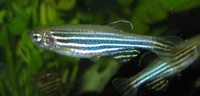
Image Source:
https://commons.wikimedia.org/wiki/File:Zebrafisch.jpg

My primary research interest was to understand how regeneration functions: how it is initiated, how the regenerating tissue achieves the correct size and shape, and how it is terminated. To investigate these questions, I worked on analyzing these mechanisms of control in zebrafish fin regeneration. Zebrafish are particularly suited for this study as they have the ability to regenerate a wide variety of tissues including their fins, heart, spinal cord, retina, optic nerve, and ear sensory cells. A secondary interest was also to determine where the regenerated cells arise from, what cell types they form, and what dynamic behaviors they exhibit (such as division rate, localization, etc.). The primary technology I utilized was quantitative high-resolution imaging, which allows for exact cell tracking and mapping of a regenerating fin, as zebrafish are nearly entirely transparent during their development. These experiments will hopefully give us insight into not only the basic questions of how regeneration functions, but also help in developing future regenerative therapies in humans to repair damage from injury, disease, or aging.
You can also read about my computational research in
the Wall Lab, my undergraduate research in the About Me section,
and my links to research tools.